
Kia Forte: Maintenance / Tires and wheels
Tire care
For proper maintenance, safety, and maximum fuel economy, you must always maintain recommended tire inflation pressures and stay within the load limits and weight distribution recommended for your vehicle.
Recommended cold tire inflation pressures
All tire pressures (including the spare) should be checked when the tires are cold. “Cold Tires” means the vehicle has not been driven for at least three hours or driven less than 1.6 km (one mile).
Recommended pressures must be maintained for the best ride, top vehicle handling, and minimum tire wear.
For recommended inflation pressure refer to the “Ties and wheels” section in Chapter 8.
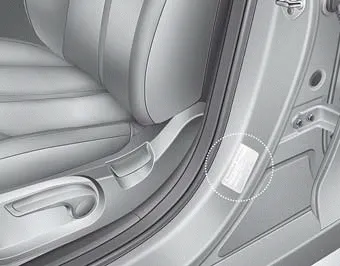
All specifications (sizes and pressures) can be found on a label attached to the driver’s side center pillar.
WARNING - Tire underinflation
Inflate your tires consistent with the instructions provided in this manual.
Regularly check the tire inflation pressure, and correct it as needed.
Driving on under-inflated tires not only compromises your vehicle's driving stability but also may lead to tire damage and the risk of an accident. Severe under inflation (70kPa (10 psi) or more) can lead to severe heat build up, causing blowouts, tread separation and other tire failures that can result in the loss of vehicle control. This risk is much higher on hot days and when driving for long periods at high speeds.
Failure to maintain specified pressure may result in excessive wear, poor handling, reduced fuel economy, deformation of the tire and/or wheel, harsh ride conditions, possibility for additional damage from road hazards, or result in tire failure.
- Tire pressure
- Checking tire inflation pressure
- Tire rotation
- Wheel alignment and tire balance
- Tire replacement
- Wheel replacement, Tire traction & maintenance
- Tire sidewall labeling
- Tire terminology and definitions
- All season, Summer, Snow tires
- Radial-ply tires
- Low aspect ratio tire
The following should be reset after the battery has been discharged or the battery has been disconnected. Auto up/down window (See Chapter 4) Sunroof (See Chapter 4) Trip computer (See Chapter 4) Climate control system (See Chapter 4) Driver position memory system (See Chapter 3) Audio (See Chapter 4)
Always observe the following: Check tire pressure when the tires are cold. (After vehicle has been parked for at least three hours or hasn't been driven more than 1.
Other information:
Kia Forte 2019-2024 (BD) Owner's Manual: Components of the Tire Mobility Kit (TMK)
1. Speed restriction label 2. Sealant bottle and label with speed restriction 3. Filling sealant and air hose from sealant bottle to wheel 4. Connectors and cable for the power outlet direct connection 5. Holder for the sealant bottle 6.
Kia Forte 2019-2024 (BD) Owner's Manual: Tail lamp (inside) (Bulb type) bulb replacement (Rear combination lamp Type A)
1. Open the trunk lid. 2. Loosen the retaining screw of the trunk lid cover. Remove the trim mounting clip and take off the cover. 3. Remove the socket from the assembly by turning the socket counterclockwise until the tabs on the socket align with the slots on the assembly.
Categories
- Manuals Home
- Kia Forte Owners Manual
- Folding the rear seat
- Battery replacement
- Maintenance
- New on site
- Most important about car
