
Kia Forte: Tires and wheels / Tire rotation
To equalize tread wear, it is recommended that the tires be rotated every 12,000 km (7,500 miles) or sooner if irregular wear develops.
During rotation, check the tires for correct balance.
When rotating tires, check for uneven wear and damage. Abnormal wear is usually caused by incorrect tire pressure, improper wheel alignment, outof- balance wheels, severe braking or severe cornering. Look for bumps or bulges in the tread or side of the tire. Replace the tire if you find either of these conditions. Replace the tire if fabric or cord is visible. After rotation, be sure to bring the front and rear tire pressures to specification and check lug nut tightness.
Refer to the “Ties and wheels” section in Chapter 8.
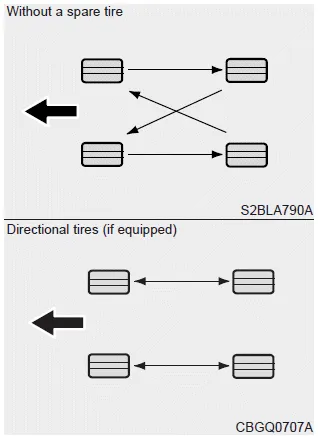
Disc brake pads should be inspected for wear whenever tires are rotated.
Rotate radial tires that have an asymmetric tread pattern only from front to rear and not from right to left.
WARNING - Mixing tires
- Do not use the compact spare tire (if equipped) for tire rotation.
- Do not mix bias ply and radial ply tires under any circumstances. This may cause unusual handling characteristics.
Check your tires once a month or more. Also, check the tire pressure of the spare tire. How to check Use a good quality gauge to check tire pressure.
The wheels on your vehicle were aligned and balanced carefully at the factory to give you the longest tire life and best overall performance. In most cases, you will not need to have your wheels aligned again.
Other information:
Kia Forte 2019-2024 (BD) Owner's Manual: Air cleaner
Filter replacement The air filter must be replaced when necessary, and should not be washed. While inspecting the air cleaner compartment, the air filter can be cleaned using compressed air. 1. Loosen the air cleaner cover attaching clips and open the cover.
Kia Forte 2019-2024 (BD) Owner's Manual: All season, Summer, Snow tires
All season tires Kia specifies all season tires on some models to provide good performance for use all year round, including snowy and icy road conditions. All season tires are identified by ALL SEASON and/or M+S (Mud and Snow) on the tire sidewall.
Categories
- Manuals Home
- Kia Forte Owners Manual
- Normal Maintenance Schedule - Non Turbo Models
- Battery replacement
- Specifications & Consumer information
- New on site
- Most important about car
