
Kia Forte: Gauges / Fuel gauge
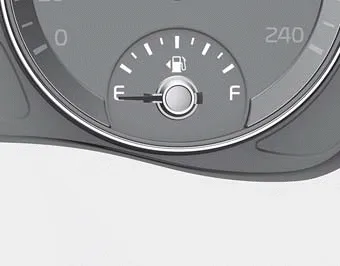
The fuel gauge indicates the approximate amount of fuel remaining in the fuel tank. The fuel tank capacity is indicated in Chapter 8. The fuel gauge is supplemented by a low fuel warning light, which will illuminate when the fuel tank is nearly empty.
On inclines or curves, the fuel gauge pointer may fluctuate or the low fuel warning light may come on earlier than usual due to the movement of fuel in the tank.
✽ NOTICE - Fuel gauge
Running out of fuel can expose vehicle occupants to danger. You must stop and obtain additional fuel as soon as possible after the warning light comes on or when the gauge indicator comes close to the “E (Empty)” level.
CAUTION - Low fuel
Avoid driving with an extremely low fuel level. Running out of fuel could cause the engine to misfire, damaging the catalytic converter.
✽ NOTICE
The fuel display may not be accurate if the vehicle is on an incline.
This gauge shows the temperature of the engine coolant when the ignition switch is ON. If the gauge pointer moves beyond the normal range area toward the “H” position, it indicates overheating that may damage the engine.
Odometer Odometer The odometer indicates the total distance the vehicle has been driven. You will also find the odometer useful to determine when periodic maintenance should be performed.
Other information:
Kia Forte 2019-2024 (BD) Owner's Manual: Normal Maintenance Schedule - Non Turbo Models
The following maintenance services must be performed to ensure good emission control and performance. Keep receipts for all vehicle emission services to protect your warranty. Where both mileage and time are shown, the frequency of service is determined by whichever occurs first.
Kia Forte 2019-2024 (BD) Owner's Manual: Specifications & Consumer information
Dimensions Engine Bulb wattage Tires and wheels CAUTION When replacing tires, use the same size originally supplied with the vehicle. Using tires of a different size can damage the related parts or make them work irregularly. ✽ NOTICE It is permissible to add 21 kPa (3 psi) to the standard tire pressure specificatio
Categories
- Manuals Home
- Kia Forte Owners Manual
- Recommended lubricants and capacities
- Battery replacement
- Your vehicle at a glance
- New on site
- Most important about car
