
Kia Forte: Gauges / Fuel gauge
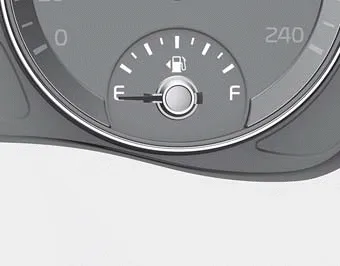
The fuel gauge indicates the approximate amount of fuel remaining in the fuel tank. The fuel tank capacity is indicated in Chapter 8. The fuel gauge is supplemented by a low fuel warning light, which will illuminate when the fuel tank is nearly empty.
On inclines or curves, the fuel gauge pointer may fluctuate or the low fuel warning light may come on earlier than usual due to the movement of fuel in the tank.
✽ NOTICE - Fuel gauge
Running out of fuel can expose vehicle occupants to danger. You must stop and obtain additional fuel as soon as possible after the warning light comes on or when the gauge indicator comes close to the “E (Empty)” level.
CAUTION - Low fuel
Avoid driving with an extremely low fuel level. Running out of fuel could cause the engine to misfire, damaging the catalytic converter.
✽ NOTICE
The fuel display may not be accurate if the vehicle is on an incline.
This gauge shows the temperature of the engine coolant when the ignition switch is ON. If the gauge pointer moves beyond the normal range area toward the “H” position, it indicates overheating that may damage the engine.
Odometer Odometer The odometer indicates the total distance the vehicle has been driven. You will also find the odometer useful to determine when periodic maintenance should be performed.
Other information:
Kia Forte 2019-2024 (BD) Owner's Manual: Components of the Tire Mobility Kit (TMK)
1. Speed restriction label 2. Sealant bottle and label with speed restriction 3. Filling sealant and air hose from sealant bottle to wheel 4. Connectors and cable for the power outlet direct connection 5. Holder for the sealant bottle 6.
Kia Forte 2019-2024 (BD) Owner's Manual: Engine compartment fuse panel
Engine room compartment fuse panel Engine room compartment fuse panel Relay Engine compartment fuse panel (Battery terminal cover) ✽ NOTICE Not all fuse panel descriptions in this manual may be applicable to your vehicle.
Categories
- Manuals Home
- Kia Forte Owners Manual
- Battery replacement
- Normal Maintenance Schedule - Turbo Models
- Trunk
- New on site
- Most important about car
