
Kia Forte: Steering wheel / Tilt and telescopic steering
Tilt steering allows you to adjust the steering wheel before you drive. You can also raise it to give your legs more room when you exit and enter the vehicle.
The steering wheel should be positioned so that it is comfortable for you to drive, while permitting you to see the instrument panel warning lights and gauges.
WARNING - Steering wheel adjustment
Never adjust the angle and height of the steering wheel while driving. You may lose steering control
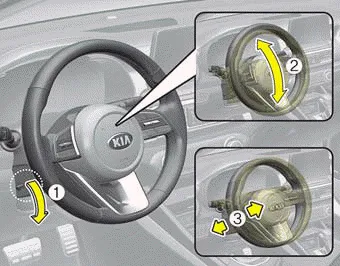
To change the steering wheel angle, pull down the lock release lever (1), adjust the steering wheel to the desired angle (2) and height (3), then pull up the lock-release lever to lock the steering wheel in place. Be sure to adjust the steering wheel to the desired position before driving.
✽ NOTICE
After adjustment, sometimes the lock release lever may not lock the steering wheel. It is not a malfunction.
This occurs when two gears are not engaged correctly. In this case, adjust the steering wheel again and then lock the steering wheel.
Electric power steering (EPS) Power steering uses a motor to assist you in steering the vehicle. If the engine is off or if the power steering system becomes inoperative, the vehicle may still be steered, but it will require increased steering effort.
Horn To sound the horn, press the horn symbol on your steering wheel. Check the horn regularly to be sure it operates properly. To sound the horn, press the area indicated by the horn symbol on your steering wheel mainly (see illustration).
Other information:
Kia Forte 2019-2024 (BD) Owner's Manual: Tire pressure
Always observe the following: Check tire pressure when the tires are cold. (After vehicle has been parked for at least three hours or hasn't been driven more than 1.6 km (one mile) since startup.) Check the pressure of your spare tire each time you check the pressure of other tires.
Kia Forte 2019-2024 (BD) Owner's Manual: Light bulb position (Front)
Categories
- Manuals Home
- Kia Forte Owners Manual
- Engine oil
- Maintenance
- Maintenance services
- New on site
- Most important about car
