
Kia Forte: LCD display for transmission temperature and warning message / Paddle shifter
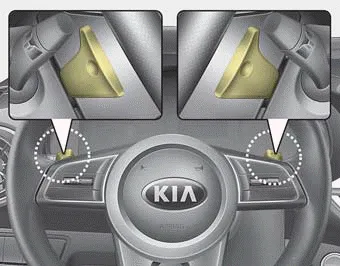
The paddle shifter is available when the shift lever is in the D (Drive) position or the manual mode.
With the shift lever in the D position
The paddle shifter will operate when the vehicle speed is more than 10 km/h (6.2 mph).
Pull the [+] or [-] paddle shifter once to shift up or down one gear and the system changes from automatic mode to manual mode.
When the vehicle speed is lower than 10 km/h (6.2 mph), if you depress the accelerator pedal for more than 5 seconds or if you move the shift lever from D (Drive) to manual Mode and move it from manual Mode to D (Drive) again, the system changes from manual mode to automatic mode.
With the shift lever in the sports mode
Pull the [+] or [-] paddle shifter once to shift up or down one gear.
✽ NOTICE
If the [+] and [-] paddle shifters are pulled at the same time, gear shift may not occur.
Shift-lock override
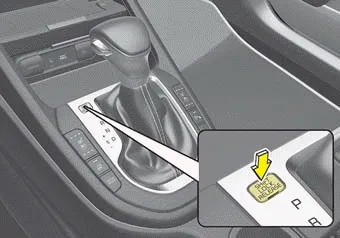
Type A
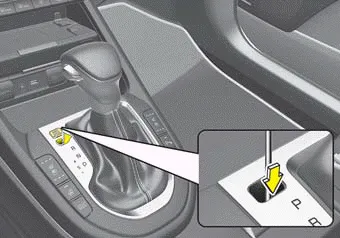
■ Type B
If the shift lever cannot be moved from the P (Park) position into the R (Reverse) position with the brake pedal depressed, continue depressing the brake, then do the following:
1. Place the ignition switch in the
LOCK/OFF position.
2. Apply the parking brake.
3. Carefully remove the cap (1) covering
the shift-lock release access
hole.
4. Insert a tool (e.g. flathead screwdriver)
into the access hole and
press down on the tool.
5. Move the shift lever.
6. Remove the tool from the shiftlock
override access hole then install
the cap.
7. Have the system inspected by a
professional workshop. Kia recommends
to visit an authorized Kia
dealer/service partner.
The indicator in the instrument cluster displays the shift lever position when the ignition switch is in the ON position. P (Park) Always come to a complete stop before shifting into P (Park).
The ignition key cannot be removed unless the shift lever is in the P (Park) position. Good driving practices Never move the shift lever from P (Park) or N (Neutral) to any other position with the accelerator pedal depressed.
Other information:
Kia Forte 2019-2024 (BD) Owner's Manual: Notes on the safe use of the Tire Mobility Kit
Park your car at the side of the road so that you can work with the Tire Mobility Kit away from moving traffic. To be sure your vehicle will not move, even when you're on fairly level ground, always set your parking brake. Only use the Tire Mobility Kit for sealing/inflation passenger car tires.
Kia Forte 2019-2024 (BD) Owner's Manual: Headlamp (Low beam) bulb replacement (Headlamp Type A,B)
1. Open the hood. 2. Remove the headlamp bulb cover by turning it counterclockwise. 3. Disconnect the headlamp bulb socket-connector. 4. Remove the bulb-socket from the headlamp assembly by turning the bulb-socket counterclockwise until the tabs on the bulb-socket align with the slots on the headlamp assembly.
Categories
- Manuals Home
- Kia Forte Owners Manual
- Recommended lubricants and capacities
- Normal Maintenance Schedule - Turbo Models
- Engine coolant
- New on site
- Most important about car
