
Kia Forte: Inflation and non-inflation conditions of the air bag / Air bag inflation conditions
Front air bags
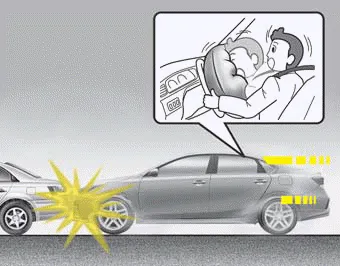
Front air bags are designed to inflate in a frontal collision depending on the intensity, speed or angles of impact of the front collision.
Side and/or curtain air bags
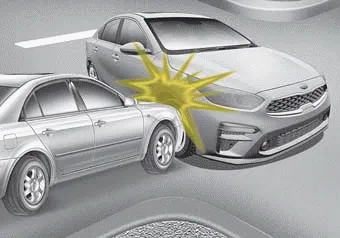
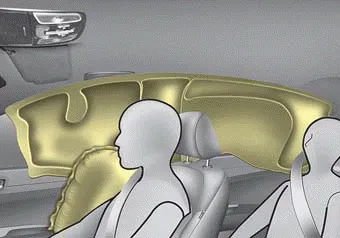
Side and/or curtain air bags are designed to inflate when an impact is detected by side collision sensors depending on the strength, speed or angles of impact resulting from a side impact collision.
Also, the side and curtain air bags are designed to inflate when a rollover is detected by a rollover sensor.
Although the front air bags (driver’s and front passenger’s air bags) are designed to inflate in frontal collisions, they also may inflate in other types of collisions if the front impact sensors detect a sufficient frontal force in another type of impact. Side and curtain air bags are designed to inflate in certain side impact collisions. They may inflate in other types of collisions where a side force is detected by the sensors. Side air bag and/or curtain air bags may also inflate where rollover sensors indicate the possibility of a rollover occurring (even if none actually occurs) or in other situations, including when the vehicle is tilted while being towed.
Even where side and/or curtain air bags would not provide impact protection in a rollover, they may deploy to prevent ejection of occupants, especially those who are restrained with seat belts.
If the vehicle chassis is impacted by bumps or objects on unimproved roads, the air bags may deploy. Drive carefully on unimproved roads or on surfaces not designed for vehicle traffic to prevent unintended air bag deployment.
(1) SRS control module/ Rollover sensor (2) Front impact sensor (3) Side impact sensor (4) Side impact sensor WARNING - Air bag sensors Do not hit or allow any objects to impact the locations where air bags or sensors are installed.
• In certain low-speed collisions, the air bags may not deploy. The air bags are designed not to deploy in such cases because they may not provide benefits beyond the protection of the seat belts in such collisions.
Other information:
Kia Forte 2019-2024 (BD) Owner's Manual: All season, Summer, Snow tires
All season tires Kia specifies all season tires on some models to provide good performance for use all year round, including snowy and icy road conditions. All season tires are identified by ALL SEASON and/or M+S (Mud and Snow) on the tire sidewall.
Kia Forte 2019-2024 (BD) Owner's Manual: Stop and tail lamp (LED type) bulb replacement (Rear combination lamp Type B)
If the stop and tail lamp (LED) (1,2,3) does not operate, have the vehicle checked by an authorized Kia dealer. The LED lamp cannot be replaced as a single component because it is an integrated unit. The LED lamp has to be replaced with the unit.
Categories
- Manuals Home
- Kia Forte Owners Manual
- Folding the rear seat
- Engine coolant
- Features of your vehicle
- New on site
- Most important about car
