
Kia Forte: Driving your vehicle / Cruise Control System
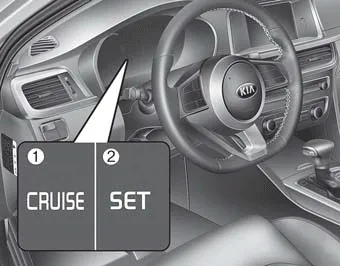
The cruise control system allows you to program the vehicle to maintain a constant speed without depressing the accelerator pedal.
This system is designed to function above approximately 30 km/h (20 mph).
If the cruise control system is left on, (CRUISE indicator light in the instrument cluster illuminated), the cruise control can be switched on accidentally. Keep the cruise control system off (CRUISE indicator light OFF) when the cruise control is not in use, to avoid inadvertently setting a speed.
Use the cruise control system only when traveling on open highways in good weather.
Do not use the cruise control when driving in heavy or varying traffic,or on slipper (rainy, icy, or snow-covered) or winding roads, or on roads with an over 6% up-hill or down-hill grade.
✽ NOTICE
- During normal cruise control operation, when the SET switch is activated or reactivated after applying the brakes, the cruise control will activate after approximately 3 seconds. This delay is normal.
- To activate cruise control, depress the brake pedal at least once after turning the ignition switch to the ON position or starting the engine.
WARNING - Misuse of Cruise Control
Do not use cruise control if the traffic situation does not allow you to drive safely at a constant speed and with sufficient distance to the vehicle in front.
- To set cruise control speed
- To increase cruise control set speed
- To decrease the cruising speed
- To cancel cruise control, do one of the following
- To resume cruising speed at more than approximately 30 km/h (20 mph)
- To turn cruise control off, do one of the following
- The pedestrian is not fully detected by the camera sensor, or the pedestrian is not walking in the upright position. - The pedestrian moves very fast.
1. Press the CRUISE button on the steering wheel to turn the system on. The CRUISE indicator light in the instrument cluster will illuminate. 2.
Other information:
Kia Forte 2019-2024 (BD) Owner's Manual: Blade replacement
When the wipers no longer clean adequately, the blades may be worn or cracked, and require replacement. To prevent damage to the wiper arms or other components, do not attempt to move the wipers manually. Aftermarket wiper blades may result in wiper malfunction and/or failure.
Kia Forte 2019-2024 (BD) Owner's Manual: Tail lamp (inside) (Bulb type) bulb replacement (Rear combination lamp Type A)
1. Open the trunk lid. 2. Loosen the retaining screw of the trunk lid cover. Remove the trim mounting clip and take off the cover. 3. Remove the socket from the assembly by turning the socket counterclockwise until the tabs on the socket align with the slots on the assembly.
Categories
- Manuals Home
- Kia Forte Owners Manual
- Safety features of your vehicle
- Check tire pressure
- Trunk
- New on site
- Most important about car
